Ghostbusters (1984)
When Gozer the Gozerian commanded the Ghostbusters to choose the form of their destructor, Ray Stantz attempted to empty his mind but landed on a childhood memory: roasting Stay Puft Marshmallows around the campfire at Camp Waconda. That single lapse of concentration manifested Gozer as a 112.5-foot-tall homicidal marshmallow man, the brand mascot of the Stay Puft Marshmallow Company, bent on destroying the Ghostbusters, New York City, and the world. Gozer's choice of final form was foreshadowed twice earlier in the film: Stay Puft Marshmallow bags appear in Dana Barrett's grocery haul, and a billboard for the brand is visible near the Firehouse.
Stay Puft marched through Columbus Circle toward the Shandor Building at 550 Central Park West, stepping on a church adjacent to the building before beginning to scale its exterior toward the Temple of Gozer on the roof. The Ghostbusters fired their proton packs at him, setting him ablaze but only enraging him further. At Egon Spengler's direction, the team crossed the streams into the temple gateway. The resulting explosion destroyed the temple, part of the building, and Stay Puft himself. Marshmallow residue showered the surrounding streets, with a large glob landing directly on Walter Peck.
Dan Aykroyd, co-writer and co-star, has noted that the Stay Puft Marshmallow Man is one of the few elements that survived from his original early drafts of the screenplay. In those drafts, Stay Puft emerged from the East River; a later pre-production version had him rise near the Statue of Liberty. Both were set aside partly due to cost.
Ghostbusters II
Stay Puft does not appear in the sequel. Ray Stantz and Winston Zeddemore allude to the first battle with him in 1989, following their performance at a child's birthday party.
Ghostbusters: The Video Game (2009)
During the Thanksgiving weekend of 1991, the Cult of Gozer's manipulation of the Mandala allowed Gozer the Gozerian to re-enter the physical plane, once again in the form of the Stay Puft Marshmallow Man, now rampaging through Times Square. Ray theorized there is "one Destructor Form per god per dimension," explaining why Gozer reverts to this same shape in Earth's dimension regardless of opportunity. In-game, the Stay Puft Marshmallow Man is classified as a Class VII Outsider Avatar and a Deity.
Because Gozer's penetration of the human realm was incomplete, this incarnation was weaker than the original. The Rookie Ghostbuster ultimately defeated him alone using the Boson Dart, a new proton pack attachment. During the encounter Stay Puft demonstrated a new ability: spawning Marshmallow Minis from his own ectoplasmic residue. At the end of the battle his giant sailor's hat tumbled onto a neighboring building, a callback to a gag cut from the original film's finale. The development team was told from the outset that if Stay Puft appeared in the game, he had to be in the "Panic in Times Square" level. Glenn Gamble led the texturing work for Stay Puft in the Realistic Version of the game and also aided in designing the boss fight, including the battle-scarring that accumulates as the player damages him.
The Real Ghostbusters (1986)
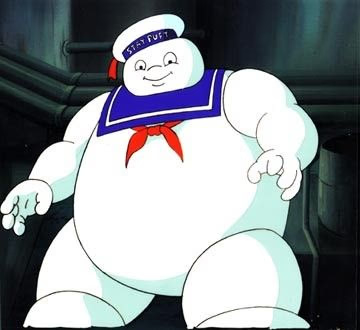
In the animated continuity, Stay Puft transitioned from antagonist to reluctant ally after his defeat at the hands of the original Ghostbusters. The Real Ghostbusters largely treated Stay Puft as a being separate from Gozer rather than an avatar of that deity, which was an acknowledged creative choice by the series.
Stay Puft appeared as an antagonist in the unaired pilot, and was present in the original Season 1 opening title sequence. Notable episodes include:
- "Mr. Sandman, Dream Me a Dream": A dream-manifestation of Stay Puft appears as a by-product of a sleeping boy carrying a bag of Stay Puft Marshmallows.
- "Citizen Ghost": The Ghostbusters return to the Firehouse still covered in marshmallow residue from their fight with Gozer. This episode takes place directly after the events of the 1984 film.
- "Cry Uncle": Stay Puft is accidentally released from the Containment Unit by Egon Spengler's skeptical uncle Cyrus. Egon recaptures him by laying four or five Ghost Traps in sequence and tripping Stay Puft onto them with a cable.
- "Deadcon 1": Janine Melnitz releases Stay Puft to attend a ghost convention as a guest of honor. He ends up winning a Best Costume Award from the American Association for the Advancement of Oral Hygiene, whose dentist convention was running simultaneously.
- "The Revenge of Murray the Mantis": The Ghostbusters release Stay Puft to fight a giant ghost taking the form of the Murray the Mantis Thanksgiving Day Parade balloon. Egon calculated Murray's energy level at 45 times 10 to the 14th power megawatts, comparable to Gozer's. Stay Puft defeats Murray in Central Park and takes his place as a substitute parade float.
- "Sticky Business": The Stay Puft Marshmallow Company offers the Ghostbusters $50,000 to use Stay Puft in a commercial benefiting a children's hospital ward. Slimer retrieves Stay Puft from the Containment Unit and relays the situation; Stay Puft agrees to help for the sake of the children.
Stay Puft's abilities and vocabulary shifted across the run. In "Cry Uncle" and "The Revenge of Murray the Mantis" he could not speak and communicated only through grunts and growls. By "Deadcon 1" and "Sticky Business" he spoke fluent English, though his grammar was inconsistent within individual episodes. He was voiced by Frank Welker and Maurice LaMarche at different points in the series. Stay Puft was one of only two film characters, alongside Slimer, to receive his own figure in the original Kenner toy line for the series.
IDW Comics
In the IDW continuity, the Ghostbusters captured much of Gozer's essence after the Shandor incident and stored it in the Containment Unit. During the Infestation event, a containment breach allowed Gozer's essence to escape and Stay Puft to reform, marching on West 57th Street. The Ghostbusters attempted a massive ectoplasmic cross-pollination, inoculating him with recaptured Poltergeists to weaken him. Stay Puft tore himself apart in the process, creating a necrotic zombie doppelganger. After the doppelganger was destroyed, the split affected Stay Puft at a molecular level and caused him to eventually disperse, with Egon Spengler noting he would eventually reform and trigger another uptick in supernatural activity.
Later, Ray Stantz completed the Megatrap, designed to capture large entities in a single shot. When Gozer returned for a Re-Selection of Destructor Form, Ray's spirit guide influenced his thoughts toward Stay Puft once again. Ray used the Megatrap from inside room 2206 of the Shandor Building to trap enough of Gozer's essence to defeat Stay Puft. The resulting explosion covered a square mile of Manhattan with up to six inches of marshmallow residue and caused heavy utility damage across most of Central Park.
The IDW Comics also classify Stay Puft differently from his film counterpart: rather than strictly a Deity, the Paranormal Contracts Oversight Commission file on Stay Puft describes him as a psychokinetically charged and ectoplasmically animated gateway homunculus. The files note that with each reformation, more latent psychokinetic energy is drawn into the creature to compensate for Gozer's deficiencies, causing Stay Puft to become progressively more of a separate entity from Gozer over time. In theory this makes him increasingly susceptible to domination by other intelligent powers.
Casting and Design
The Stay Puft Marshmallow Man was inspired by three existing characters: the Pillsbury Doughboy, the Michelin Man, and the Angelus Puft Marshmallow Man. Dan Aykroyd described him as a corporate mascot analogous to the Michelin Man, manipulated by Gozer.
Sculptor Linda Frobos recommended Bill Bryan to build the suits and to perform the character on screen. The first suit was built entirely from soft foam, but Bryan identified a problem during early test filming: when he walked toward the camera his legs compressed the foam in an unflattering way. Jon Berg was brought in as a consultant and suggested a fiberglass body, but Bryan resisted on safety grounds. The team eventually adopted foam with an L200 internal structure, which solved the problem.
The finished suits stood approximately 6 to 6.5 feet tall; Bryan himself was 5 feet 8 inches, which put him at roughly Stay Puft's midsection inside the costume. The head was built around a fiberglass skull with cable-actuated mechanisms for facial movement, operated by a team of four puppeteers beneath an elevated miniature set, who observed Bryan on a video monitor as they worked the controls from a dolly truck. Three separate heads were manufactured to cover the range of expressions needed during filming.
Three hero suits were built for standard photography. An additional 18 suits were made specifically for the fire sequences, at a cost of $20,000 to $35,000 each; 17 of the 18 were burned during production. All of Stay Puft's on-screen scenes were completed over just two days at Boss Film Effects, with approximately three and a half weeks remaining before the theatrical release. Footage was shot at 72 frames per second to enhance the character's perceived weight and mass.
For the burning sequences, stuntmen Tony Cecere and Bill Couch Jr. wore fire-retardant suits rigged with pyrotechnics. During Cecere's second take, the glue inside the Stay Puft head ignited, burned through the foam, and split the head open, leaving only the pink fiberglass skull. Bill Bryan, between takes, kept a small library inside the costume's stomach compartment and read while waiting on set.
Sound designer Richard Beggs created the audio of Stay Puft's march by wetting his thumbs and pressing them against a chair covered tautly in leather, then pitch-shifting the result to match the character's implied mass.
Stay Puft's height changed substantially across script drafts. The August 5, 1983 draft described a 300-foot figure; by September 30, 1983 the height had dropped to 100 feet. During production, different factions of the crew argued for either 100 feet or 125 feet. Director Ivan Reitman settled the dispute by declaring Stay Puft would stand exactly 112.5 feet tall, while the film's novelization gives the height as 100 feet.
In every script draft prior to the final shooting script, it was Winston Zeddemore, not Ray, who inadvertently chose the Destructor Form. The character also did not become the film's climactic encounter until the July 6, 1983 draft; in earlier versions he appeared as an intermediate threat at the midpoint of the story. The concept phase also produced an alternative Destructor Form design by Thom Enriquez based on Ray's childhood pet lizard.
Harold Ramis reflected that he spent considerable time trying to rationalize Stay Puft within the film's logic, eventually concluding that mankind's deepest fears of the unknown would prove to be as insubstantial as marshmallow.
The Stay Puft Marshmallow Man is among the most recognized images in Ghostbusters iconography and a recurring subject of fan projects on GBFans.com. Community members have built large-scale foam Stay Puft costumes and parade-scale mascot suits, and discussions of the suit's construction have long been a reference point for full-body foam fabrication techniques. Kenner's original Stay Puft action figure and the later plush toy from the same line remain popular among collectors on GBFans.com.
References
- Ghostbusters (1984), Columbia Pictures
- Ghostbusters: The Video Game (2009), Atari / Terminal Reality
- The Real Ghostbusters animated series (DiC / Coca-Cola Telecommunications, 1986-1991)
- IDW Publishing, Ghostbusters comic series (Erik Burnham, 2011 onward)
- Fandom wiki, "Stay Puft Marshmallow Man"
- Fandom wiki, "Stay Puft Marshmallow Man/Animated"